Stage

Dr. Strangelove or: How I Learned to Stop Worrying and Love the Bomb
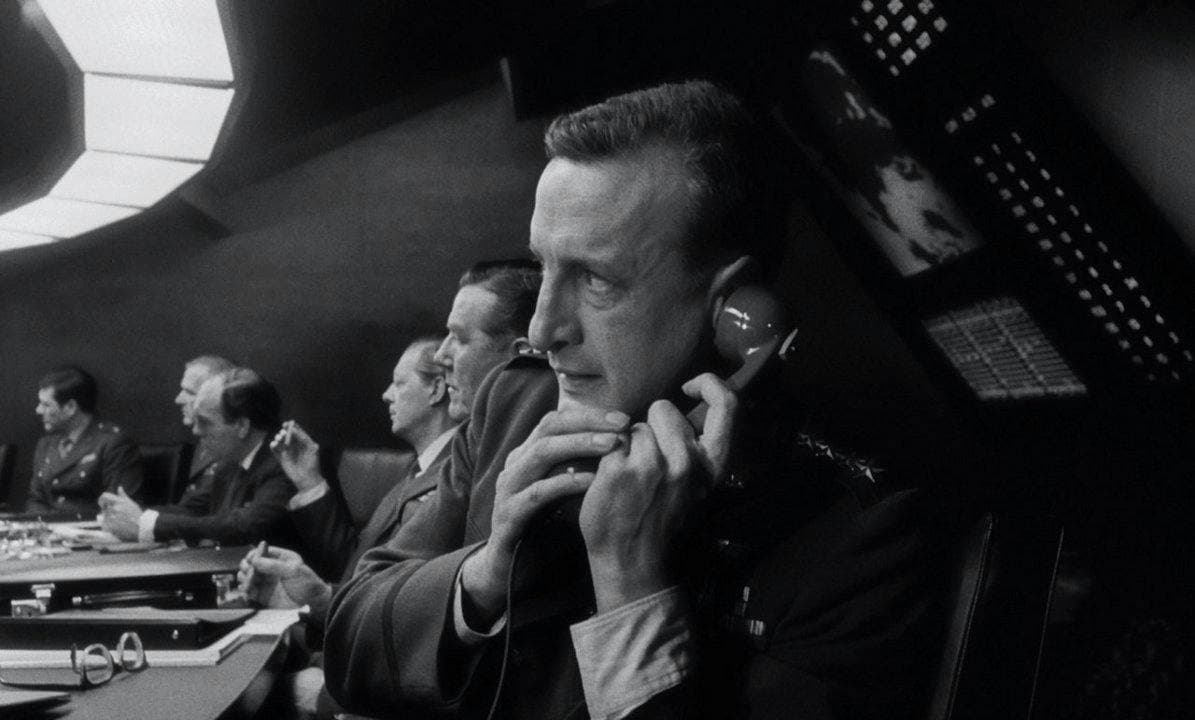
1/2
Slide 1 of 2

Stanley Kubrick's political satire Dr. Strangelove is showing at Lab111. In this black comedy classic, mutual paranoia between the US and the Soviet Union leads to an impending nuclear war. Peter Sellers plays three roles simultaneously.

Dr. Strangelove or: How I Learned to Stop Worrying and Love the Bomb

Dates

Wed 4 Nov10:05 - 11:40

Location

LAB111, Arie Biemondstraat 111, 1054 PD Amsterdam
Show in Google Maps

A dark comedic classic about the madness of the Cold War.

In Dr. Strangelove or: How I Learned to Stop Worrying and Love the Bomb, Stanley Kubrick shows how mutual paranoia between the US and the Soviet Union can escalate into a nuclear catastrophe. General Jack Ripper unilaterally orders his air force to bomb the Soviet Union. His reason: the communists are poisoning the 'precious bodily fluids' of the American people. What follows is a series of absurd attempts to stop the attack.

Peter Sellers in three roles

The heart of the film is Peter Sellers' triple acting performance. He plays Group Captain Mandrake, President Merkin Muffley, and the mysterious scientist Dr. Strangelove. Each role has its own character and tone. Sellers kept the cast and crew laughing constantly during filming, including the usually serious Kubrick. George C. Scott said he felt guilty for being paid for his role, that was how much fun he had.

Humor as a weapon against the fear of war

Kubrick uses black humor to expose the absurdity of nuclear deterrence. The scenes in the 'War Room' have become iconic, and the final images are etched into the collective memory. Dr. Strangelove is not a cheerful film, but it is a funny, sharp, and timeless film that makes you think. Are you interested? Use the link to reserve tickets for a screening at Lab111.

Accessibility

General accessibility provisions and information

Present, available or allowed

  • Service dog allowed

Provisions for people with reduced mobility

Present, available or allowed

  • Mobile payment

Not present, not available or not allowed

  • Personal assistant
  • Guide lines
  • Hearing loop (t-coil or headphones)
  • Sign language interpretation provided
  • Closed captioning
  • Open captioning
  • Hidden disability Sunflower-keycord recognised here
  • Low stimulus hours
  • Sensory experience
  • Audio description
  • Accessible information
  • Material in Braille
  • Stairs with handrail
  • Lift
  • Wheelchair accessible entrance
  • Passageways that are sufficiently wide
  • Accessible restroom

Similar in Amsterdam

Others also read