Stage

Marjan Unger lezing 2026 in het Rijksmuseum
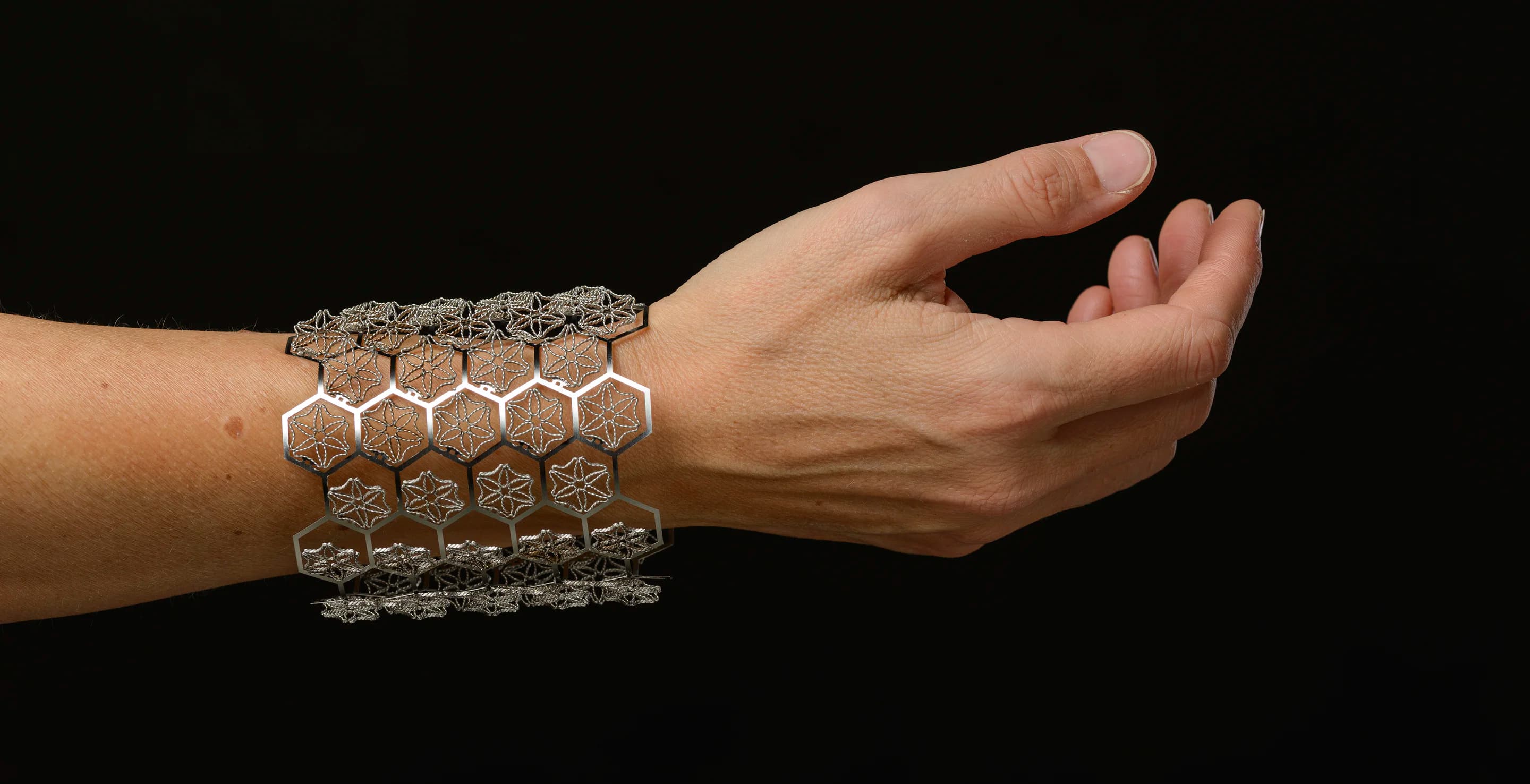
What does craftsmanship have to offer now that artificial intelligence (AI) is taking over our knowledge work? Using the fine goldsmithing technique called filigree (or filigraan), goldsmith Eva van Kempen and archaeologist Maikel Kuijpers examine what craftsmanship means – from the individual maker to the broad sweep of human history.

Marjan Unger lezing 2026 in het Rijksmuseum

Dates

Mon 2 Nov19:00 - 22:00

Location

Rijksmuseum, Museumstraat 1, 1071 XX Amsterdam
Show in Google Maps

Intelligent hands in the age of AI

"You don't have to think. Others are paid for that," American mechanical engineer Frederick Winslow Taylor is said to have said, while advocating for a scientific approach to craft work in factories to increase efficiency. This development, which took place around the turn of the 19th to the 20th century, is largely responsible for the devaluation of manual labour and the loss of human craft skills. Since then, knowledge work has been considered superior to manual labour.

Is AI going to change this? AI exposes the extent to which our daily economic tasks depend on mechanical rather than conscious reasoning. It devalues knowledge work, which raises an interesting question: what is the role of craft in the 21st century and in the context of AI?

Using filigree, we examine what craftsmanship has to offer. Craft is a way of getting to know the material world. It is fundamentally dependent on embodied knowledge and relies on intelligent hands. This is not only diametrically opposed to AI, but also appeals to other values: contentment, care, and well-being. We approach these topics from two contrasting perspectives: what making jewellery means for the individual maker and the community, and what making things contributes to the big picture of human history.

The language of this lecture is English.


About the speakers

Eva van Kempen

Eva van Kempen is an Amsterdam-based goldsmith and researcher with 26 years of experience in the craft. Since 2010, she has specialised in filigree and in the study, preservation, and innovation of this ancient wire technique. In 2020, she obtained her master's degree at the Sandberg Instituut (Gerrit Rietveld Academie). She is the founder of The Filigree Embassy and in 2021 published an article in the Journal of Jewellery Research with a strategy for the preservation of filigree as intangible cultural heritage. In 2026, she received the 'Ambassador of Filigree Award' from the Carlo Bosio Filigree Museum in Campo Ligure, Italy.

Maikel Kuijpers

Maikel Kuijpers is an assistant professor of archaeology at Leiden University. His research focuses on the way we interact with materials and how people have developed skills and knowledge about materials throughout the ages. He teaches courses on the history of materials, archaeological theory, prehistoric Europe, and science communication. Maikel obtained his PhD at the University of Cambridge. He is the author of ‘An Archaeology of Skill’ (2018) and ‘Bronze Age Metalworking in the Netherlands’ (2008), as well as numerous scientific articles. His work on prehistoric money received attention in The New York Times and on BBC radio. In addition, he has written for The Correspondent and The Conversation. In 2019, he made the short documentary The Future is Handmade. In March 2027, his first book for a general audience will be published by Penguin Press: ‘Everything Is Material. A Tangible History of Humankind’.


We thank

The biennial Marjan Unger Lezing is made possible by the Emmel Fonds / Rijksmuseum Fonds.


Programme

  • 19:00 – Doors open
  • 19:30 – Start of lecture
  • 20:30 – Drinks
  • 22:00 – End

Drinks will be served in the Foyer by the Auditorium.

Accessibility

General accessibility provisions and information

Present, available or allowed

  • Service dog allowed
  • Personal assistant
  • Wheelchair accessible entrance

Provisions for people with reduced mobility

Present, available or allowed

  • Stairs with handrail
  • Lift
  • Passageways that are sufficiently wide
  • Accessible restroom
  • Mobile payment

Provisions for people who are blind or partially sighted

Present, available or allowed

  • Guide lines
  • Sensory experience
  • Audio description
  • Accessible information

Provisions for people who are deaf or hard of hearing

Present, available or allowed

  • Hearing loop (t-coil or headphones)
  • Sign language interpretation provided
  • Closed captioning
  • Open captioning

Provisions for people who require low sensory environments

Present, available or allowed

  • Hidden disability Sunflower-keycord recognised here
  • Low stimulus hours

Not present, not available or not allowed

  • Material in Braille

Similar in Amsterdam