Viewing experience
The paintings of Christiaan Kuitwaard (1965) are always based on observation. “My work is figurative,” says the artist. “You can see what it represents. But I don’t tell stories. I am an observer, and I report on that looking.” In doing so, he strives for an image that provides just enough information to retain the viewing experience and allow it to be relived again and again. In this way, he tries to circumvent the transience of the moment and, as it were, stretch time a little. “To create an image that stays with you, it is necessary to remove as much noise as possible. You have to still it.”
Afterimage
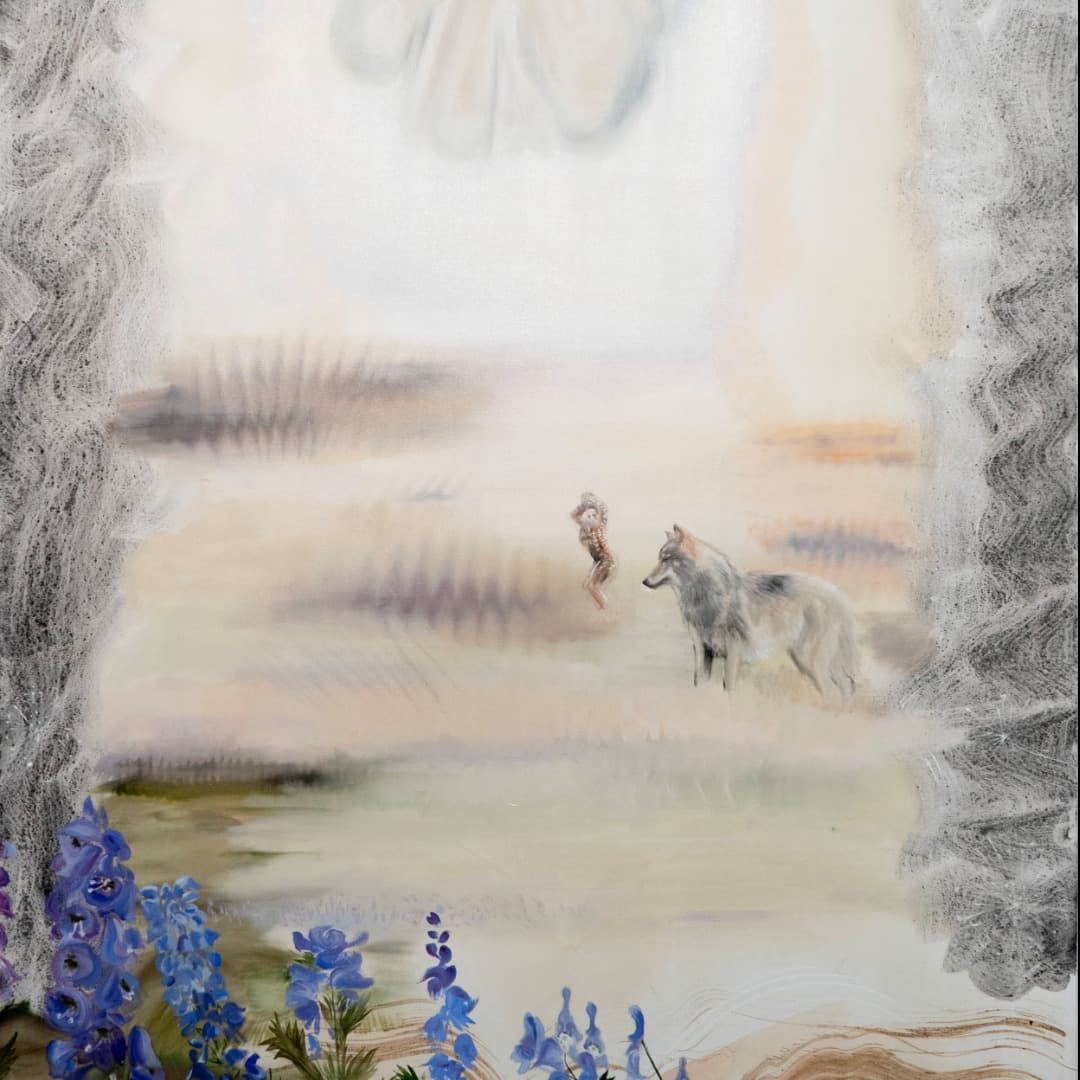
Kuitwaard is fascinated by the interplay of light and shadow, which makes things visible while simultaneously constantly changing. In his still lifes of everyday objects such as a chair or a cup and saucer, the image is primarily constructed from gradations of light. Similarly, in his interiors and landscapes—mostly beach and forest scenes—the space is defined by gradations of light and dark. Forms are blurred. The use of color is deliberately limited and subdued. Details are merely touched upon, not fully developed. Kuitwaard reduces visible reality to the bare minimum, like an afterimage on the retina. His paintings thus transcend reality, yet without losing contact.
Sanctuary
The exhibition at Museum JAN spans a period of over thirty years of painting. A steadily growing number of enthusiasts attests to the great appeal of Kuitwaard’s art. The artist considers it important that people can also express their own thoughts, experiences, or emotions through his work. “It might be sacrilege to some, but I do not really believe in art as a purely individual expression. I do not so much want to express something as to evoke something, namely silence, for myself and for others.” In a society dominated by commotion and spectacle, Kuitwaard’s paintings offer a welcome refuge.
White box paintings
A distinct group within the oeuvre consists of the 'white box paintings,' an ongoing series of still lifes based on a fixed concept. That concept involves painting a white-painted object inside a white box on a format of 28 x 20 cm. Kuitwaard began this in 2010. Within this self-imposed limitation, he constantly seeks new ways to depict any object—a block, a flower, a skull. Sometimes he paints only a shadow, sometimes only the outline, in shades of gray or in vibrant colors; sometimes sharp, sometimes blurred. With an average of one still life per week, the series is approaching the number of 700. Numbers 392 through 668 are being shown for the first time at Museum JAN. The accompanying publication features texts by well-known writers who have been inspired by the still lifes.
Outdoor studies
A third group of works consists of small-format paintings created 'en plein air' – in the open air. Most were created in Friesland, where Kuitwaard lives, or during trips to Scotland, Cornwall, and Normandy, among other places. “With the outdoor studies, looking and painting coincide,” he explains. “You become completely absorbed in it. So that is also a form of stillness.” Some studies end up in books that draw attention to the vulnerability of nature, for which the painter collaborates with poet Jan Kleefstra. Others serve as a source of inspiration for studio paintings.
Floor
Christiaan Kuitwaard’s artistic mission is as clear as it is modest: “I hope that my paintings invite people to pause a little more often – literally – to reflect on the world around us. For only by slowing down do you achieve depth. Then you suddenly see so much more.”
About Christiaan Kuitwaard
Christiaan Kuitwaard (Sneek, 1965) was born and raised in Friesland. After secondary school, he served four years in the Royal Netherlands Navy. From 1985 to 1991, he trained as a painter at the Academie Minerva in Groningen and the Constantijn Huygens University of the Arts in Kampen. Since then, Kuitwaard has exhibited regularly in museums and galleries in the Netherlands and Belgium. His work is held in the collections of the Fries Museum in Leeuwarden, Museum Belvédère in Heerenveen, and Museum MORE in Gorssel, as well as in private collections at home and abroad.