Practical information during the Canal Parade
2 June 2025
Originally published in I amsterdam Magazine Summer 2026 edition
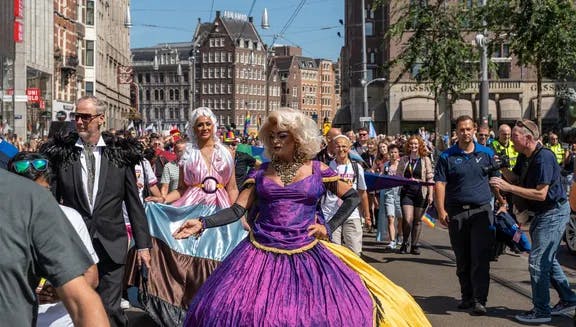
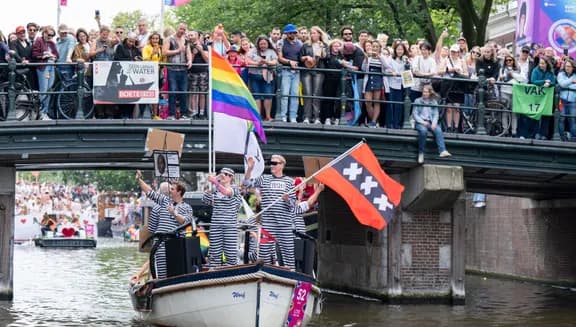
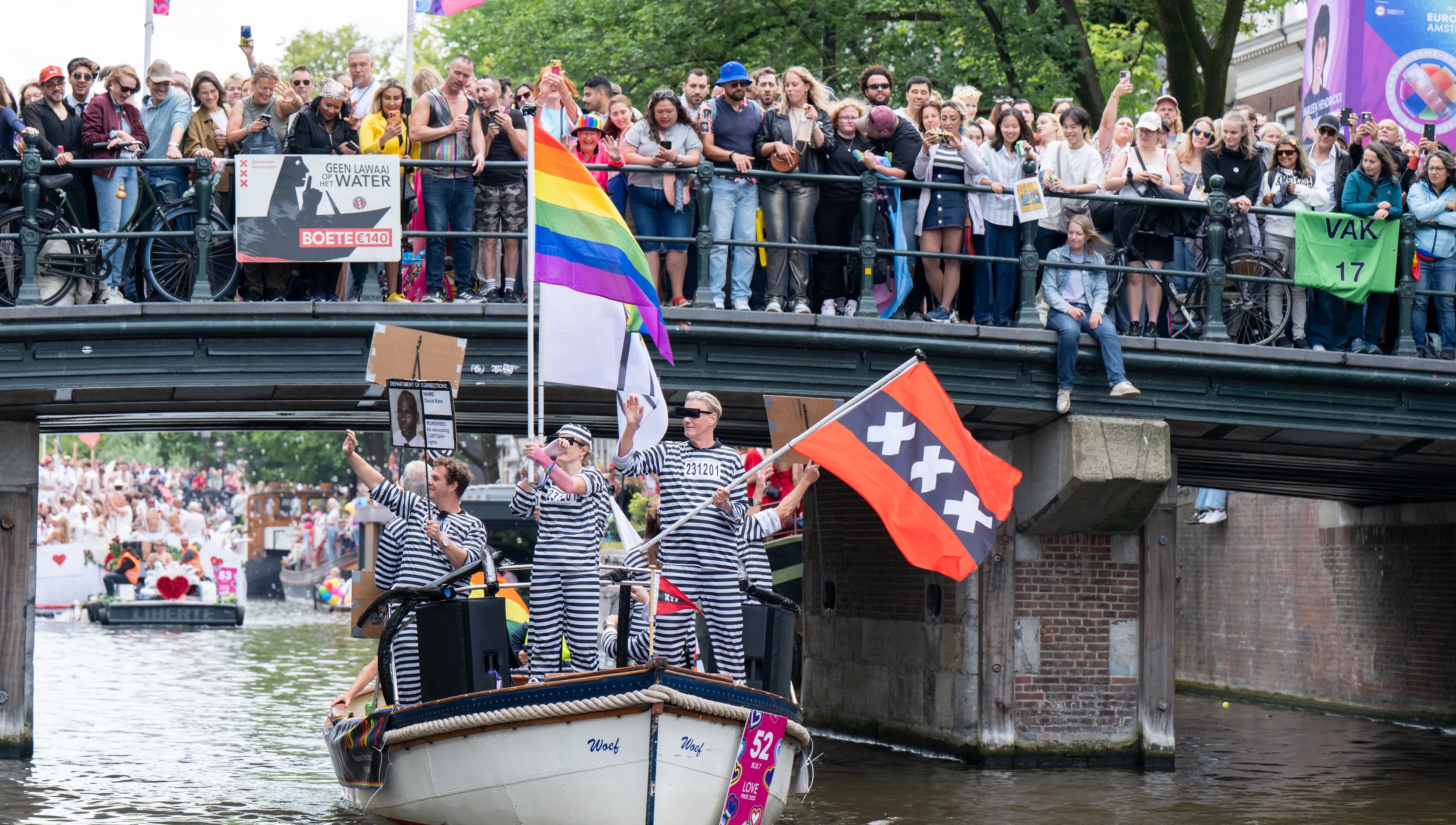
A fleet of boats glides along Amsterdam’s canals. Light catches on the surface, forming a glittering reflection of the spectacle above. People lean on bridges as crowds gather along the water. One of the first boats comes into view – a statuesque drag queen waves to the masses.
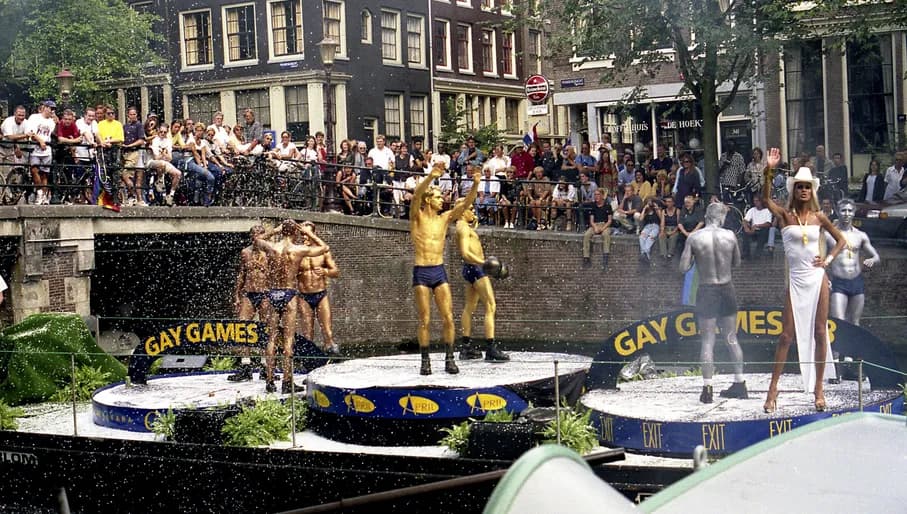
It’s no ordinary day in the capital. It’s the first Amsterdam Pride Canal Parade, organised by Gay Business Amsterdam (GBA), to celebrate the LGBTQI+ community and thank those who embraced them. For Siep de Haan, one of the GBA’s founding members, the turnout was more than he could have imagined. ‘At first I was afraid there would be no one watching’, says the 68-year-old former school teacher. ‘But the people on the first boats called me and said: ‘Siep, there are already crowds waiting on the bridges.’ When I saw Dolly Bellefleur singing at the front, I thought: this will be a success.’
He was right. Nearly three decades on, the Canal Parade has become one of the world’s biggest Pride events, attracting thousands of visitors who come every August for celebration and openness. But as Amsterdam welcomes World Pride in 2026, the city’s status as gay capital is under renewed scrutiny, as is the question of who Pride is really for and what it is meant to achieve.
Unlike Pride celebrations elsewhere, Amsterdam Pride started as a party, not a protest. Conceived as a prelude to the 1998 Gay Games, it was a way of saying thanks, says De Haan. ‘Pride everywhere else in the world started from activism. But here it was a thank you to the city and its inhabitants.’ Much of this reflects the Netherlands’ long-standing reputation for LGBTQI+ rights. It was the first country to legalise same-sex marriage back in 2001, it’s home to the oldest LGBTQI+ rights organisation in the world, known as the COC, and was one of the first countries to declassify homosexuality as a mental illness back in 1973.
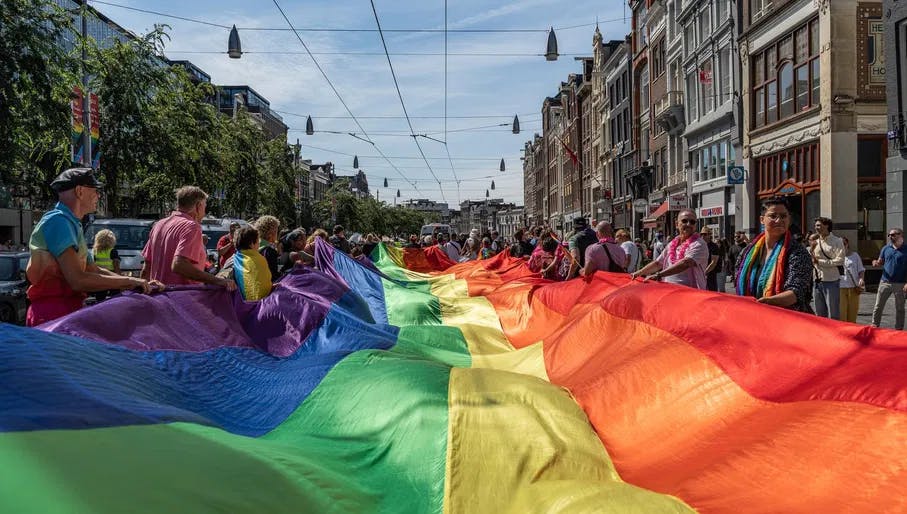
It wasn’t always so progressive. The Netherlands was once a very religious and conservative country. Jan-Willem Duyvendak, professor of sociology at the University of Amsterdam says it wasn’t until the counterculture movement of the 1960s that this began to change. ‘The country was pillarised – [meaning] society was organised by religion and nobody met outside of their pillar,’ he says. ‘Social change in the 1960s was not only enormous for LGBTQI+ people but for everyone. I don’t think there was any other country where so many people lost their faith in such a short period.’
Over the next few decades, the Netherlands became increasingly secularised. Activism existed – from a gay rights protest in 1969 to Roze Zaterdag in 1979 – but by the 1990s, many of those battles appeared, at least on paper, to have been won. Years of social liberalism helped shape Pride into something distinct, says Michiel Klaassen, a journalist at Noord-Holland Nieuws and co-author of a forthcoming book on the history of Pride in Amsterdam. ‘In the 1990s, Amsterdam was firmly on the map as the gay capital of Europe, if not the world,’ he says. ‘We had progressive coalition governments – the so-called purple cabinets – which secured first registered partnerships for same-sex couples and then same-sex marriage. The immediate need for activism within the gay and lesbian community had, to some extent, faded.’
Amsterdam Pride’s celebratory origin, however, is exactly what’s now being questioned. After years of organisational changes, Pride in Amsterdam is being asked to celebrate progress while also accounting for it. And the arrival of World Pride puts Amsterdam at the centre of a global moment and under renewed scrutiny. Lucien Spee, director of Pride Amsterdam and World Pride 2026, is optimistic they can pull off an event to remember. ‘We want to leave a legacy,’ he says. ‘Pride is a party, but it should not just be a party.’ And as TransPride organiser Yvo Manuel Vas Dias puts it: ‘Visibility alone is not enough.’
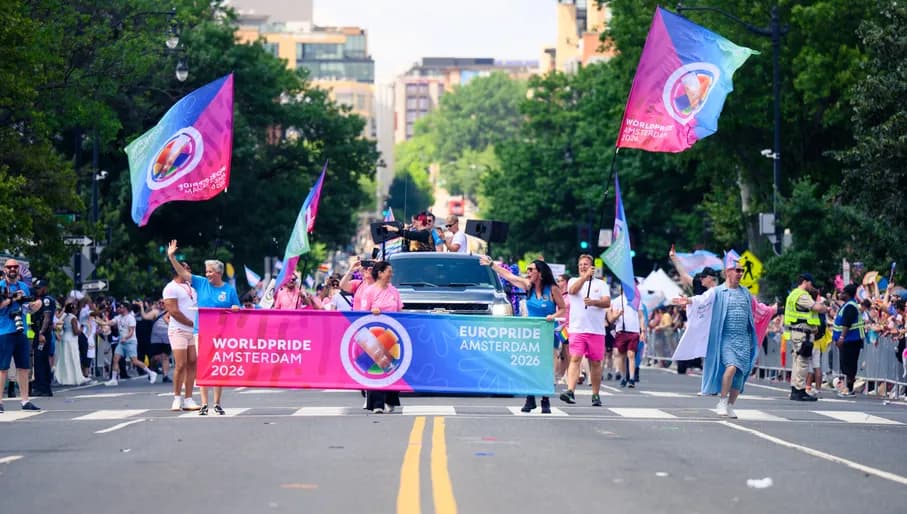
Pride has its critics. Many say it still puts too much focus on celebration and commercial visibility at the expense of the community and real issues faced within it. Others point to it being too white, too male and too geared towards the gay community, over queer and trans people. Spee acknowledges both parts but says there are reasons. ‘Thanks to the Canal Parade, we’re able to invest in a wide range of initiatives, including Trans Pride, Ballroom Pride, Religious Pride, Youth Pride and Senior Pride.’

One of the things Pride, as an organisation, is still trying to address is how to incorporate Black Pride more. Naomie Pieter, the founder of Black Pride, knows this well. But after years of organising to get black, queer and trans voices heard, she believes progress has been made through the Queer Amsterdam movement which challenged who gets to organise Pride. ‘We broke the monopoly of Pride,’ she says. ‘With Queer Amsterdam, we created an alternative Pride. Before we started, only one organisation could effectively organise Pride. After two years, the municipality changed the policy, now anyone can apply for funding and organise [their] Pride.’
World Pride arrives as reported hate crimes towards LGBTQI+ people in the Netherlands are rising sharply. According to a report conducted by the Dutch government in 2022, one-third of all discrimination reports related to sexual orientation. Meanwhile, a recent monitor by the Municipal Health Service of Amsterdam (GGD) found that less than half of young people accept same-sex relationships compared to two years earlier, when 63 per cent considered it normal.
Philip Tijsma, a spokesperson for COC Nederland, says it paints a worrying picture. While the rise in reports is due to improved reporting methods, he says it also reflects a broader trend. ‘There has been a huge increase in hatred towards LGBTQI+ people. We used to see a 3-6% growth year on year in reports – now it’s 30-40%.’ He says it’s an issue that affects trans people in particular.

For someone like Anne, a trans man and manager at queer bar Pamela, this sense of unsafety is familiar, even in supposedly safer spaces. ‘You go to a club and they say ‘We don’t accept transphobia or racism and discrimination in the house rules’,’ he explains. ‘But then you come to the bouncer and they want to pat you down and they're like, ‘Are you a man or a woman?’...[And so] you limit yourself – what bars you go to, what spaces feel safe. [Amsterdam] says ‘we’re a safe space’, but for who exactly? If you want to promote yourself as a safe-haven city, you need to do a bit more than just say it. A safe space is about accountability.’ Pride still matters, says Anne, but who it benefits remains unclear. ‘With my own changing identity from lesbian to transgender man, I see that there are marginalised voices within our community that aren’t being heard. And often those people are being silenced. They’re told: ‘now is the time to celebrate, don’t criticise everything’.’
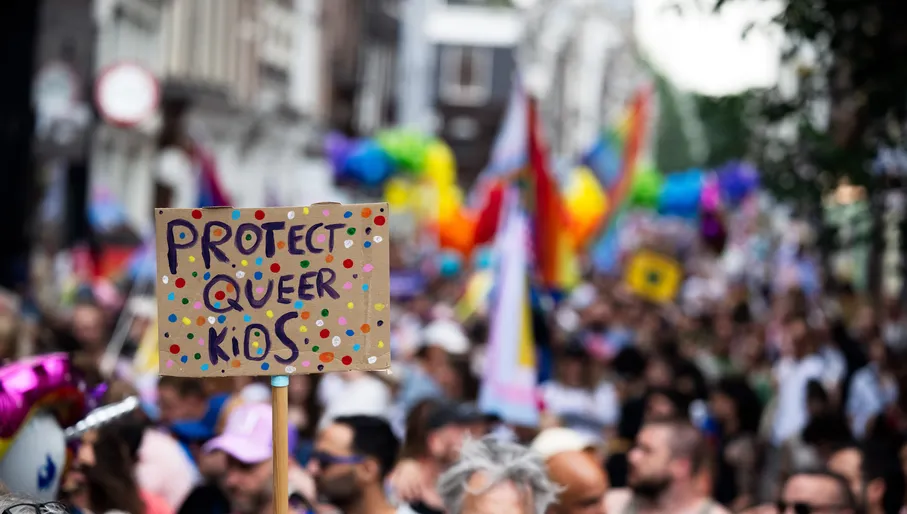
Whether World Pride can address all the issues the community faces is one thing – whether it should is another. And while Amsterdam remains at the forefront of LGBTQI+ progress, whether it can stay there is an open question. De Haan, one of the organisers of the first Canal Parade, believes the city is capable of meeting the moment, as it has before. ‘Society has become more divided,’ he says. ‘But we have to find new ways to be in solidarity. Our strength is in solidarity and respect. And I think Amsterdam still has that power.’
Pride in Amsterdam may not have been born from protest. But in 2026, it may be forced to reckon with it.