Key facts on Amsterdam's mobility industry
12 June 2025

Today, cities boast an impressive range of shared mobility solutions – from e-scooters to cargo bikes. However back in the 1970’s many urban centres congested, cars crowding the streets and polluting the air of compact cities like Amsterdam. Seeking a solution to the urban traffic problem, enterprising city council member Luud Schimmelpennink invented the world’s first shared mobility concept.
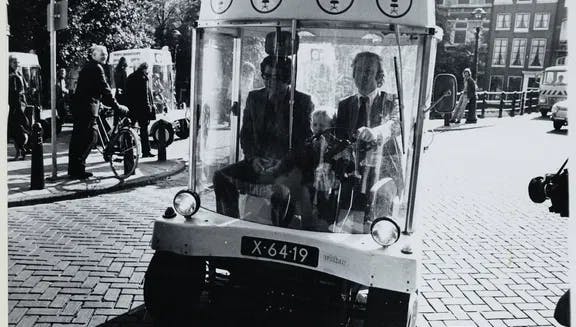
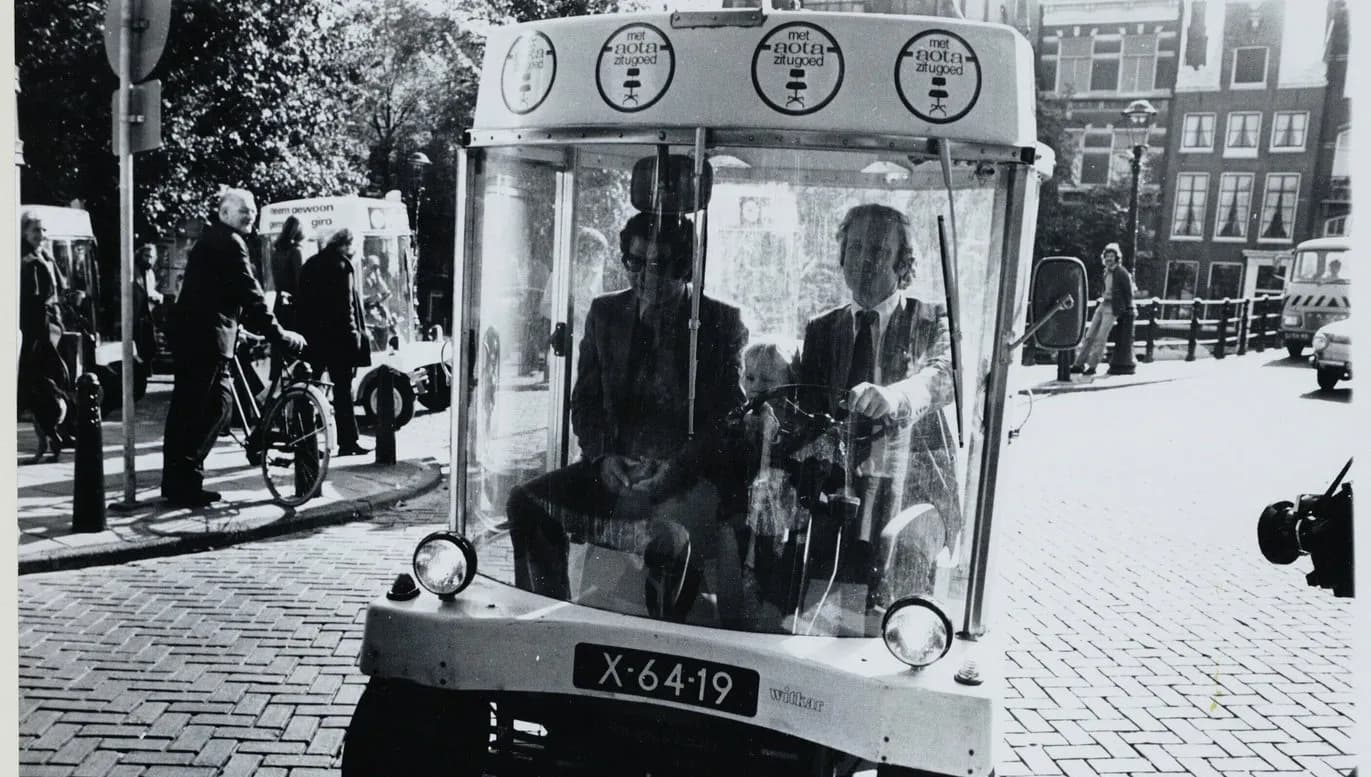
A big believer in collective transportation, Schimmelpennink first proposed a witte fietsenplan (white bicycle plan), hoping to provide thousands of bicycles free for public use and encourage residents to leave their cars outside of the city. When this plan was rejected, Schimmelpennink came up with an alternative solution that would become the world’s first successfully implemented electric car sharing system – the Witkar.

The Witkarplan as it came to be known was a collective network of electric powered vehicles. To use the two-seater cars, members would pay a lifetime fee and purchase a special electronic key that would allow them to pick up a car at one of the stations around the city.
The cars had a top speed of 30 km per hour and could sustain about 30 minutes of driving before being returned to a charging rail. The scheme was far ahead of its time, laying the groundwork for the modern smart mobility solutions we see today:
The idea was revolutionary for the time, seeing great success during its operation between 1974 and 1986. The compact design met the city’s need to free up space, while emissions-free travel was seen as a necessity to improve air quality. Residents met the plan with enthusiasm, with 2500 people already signing up for a Witkar membership before the car even launched.

At its peak, 4500 members made use of the Witkar system, and the project expanded to 5 stations. Studies carried out by the Amsterdam city council showed that with 20 Witkar stations in operation, a 10% reduction in inner city passenger traffic and 17% reduction in occupied parking spaces would be achieved. However this expansion never materialised, as the project ran out of finances to extend the network, hindering the car’s usability.
While the range of the vehicle and accessibility of the stations caused the system’s ultimate downfall, the Witkar was still an impressive demonstration of Amsterdam’s innovative approach towards urban mobility. Over 50 years later, the scheme has served as a blueprint for the modern sharing economy and Amsterdam remains at the forefront of fostering smart city solutions.