#FoundersFridays: Meet Reuben Moore of Solaq
10 October 2025
“Vibe coding” is a term that describes how non-technical people can use plain language to tell large language models (LLMs), like ChatGPT, what they want to build — and the AI generates the code for them.
Instead of writing code in a programming language, you just describe the “vibe” — what functionality you want your app or tool to have — and the AI turns that into working code.
Sure! You could tell an LLM, “Build me a dashboard that shows the number of citizens per world capital,” and it will generate that for you.
Then you can say, “Add a button so that if I press the name of the city, it takes me to Google Maps to show the location,” and it will generate that functionality.
A personal example: my boyfriend works for a municipality and had to build a website comparing municipal laws across different regions using public data. So he used Lovable, a vibe code web app builder, and within two hours he built it.
I was really happy to see AI empowering people outside of tech.
We start by checking the data (public or private?) and access (internal or external?). Then we run checks based on GDPR, the EU AI Act, and any company-specific policies they upload.
For example, if a dashboard shows demographic data by neighborhood, we mark that green. If it shows sensitive info like social security numbers, that’s flagged red.
We start with public requirements like GDPR and the EU AI Act, then layer company-specific policies to create automated checks.
So far, we’ve focused on financial services, where each bank also has its own extensive policies. The average employee won’t read through all that and translate it into what they’re trying to build. That’s where we come in. We take all those documents, extract the policies, and translate them into automated controls.
It started with studying Business IT, which is about finding IT solutions for business problems; you sit somewhere between those two worlds. Still, my first job was really technical, as a DevOps engineer. After about two and a half years, I started missing the logic behind things, like why we were doing what we were doing.
So I moved to the business side and worked on process improvement and automation projects at ING. I created automation plans across many different departments, but IT backlogs were full; business teams often had to wait over a year.
We started training business employees to build simple coding scripts themselves, because waiting wasn’t an option. As I grew into a team lead role, I set up a department focused on no-code/low-code automation — bringing in platforms that let non-technical people build applications. The market was clearly shifting in that direction.
But even when people built something, risk and compliance often blocked it from going live. People would put in the effort to learn and automate, only to be told they couldn’t use it. That’s why I started NEKOD. I thought: we need to change this. There should be an automated way to do those checks, so people aren’t stuck for months filling in forms.
Just a couple of months after coming up with the idea, I decided to quit and applied to Techstars Future of Finance, powered by ABN AMRO — and we got in!
That meant we got a €120K investment when we only had an idea and a PowerPoint deck.
And the rest is just the story of how NEKOD evolved to what it is today.
You started your company on your own. Did you get a co-founder along the way?
When I joined Techstars, I brought on a co-founder I had connected with through the Y Combinator matching platform, and we entered the program together. After a few months, we decided to part ways, and I continued leading NEKOD on my own.
It was hard. Not only did I lose a co-founder; I also didn’t have a team to build the product anymore. So I had to hire new developers and basically start again, but with the advantage of having funding.
That the team is very important—and I’m realizing that more and more. Team splits are actually the number one reason why startups fail.
It’s a tricky balance: do you stay together just for the sake of it, or is it better to split? Looking back, I’m happy we made that decision.
But being a female solo founder made fundraising a lot harder. Every investor I talked to told me I needed a co-founder—specifically, a male, tech-oriented co-founder. And I’m a software engineer myself.
There are some really good tech and fintech companies here, and the community feeling is strong.
I've been part of a few communities like Techmakers and the AI Builders group chat. One great opportunity was being able to pitch your product in front of others, especially through AI Builders. You could demo your startup there.
The Startup Village, at my old university, has also been a supportive environment.
And last but most definitely not least, I must mention AI for All (formerly Women in AI). They were instrumental in helping me take the leap into entrepreneurship.
Before I started, I was part of the AI for All community as a woman in leadership within a corporation. At one of their events, they had prizes for women in different leadership categories. One of those was for entrepreneurs.
That really brought the two worlds together—corporate and startup. It helped me see that there were women out there already building their own AI companies.
I think, in general, there needs to be more effort to bring these communities together—tech groups with women-led communities.
In areas like sustainability, healthcare, or the circular economy, you see more women. But what we do—governance, privacy, security, AI—is still male-dominated.
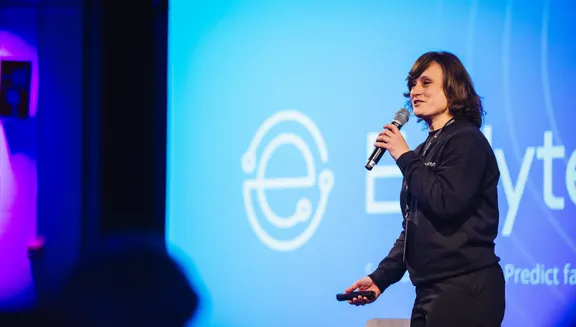
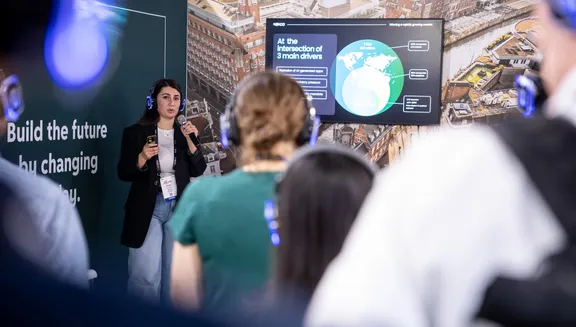
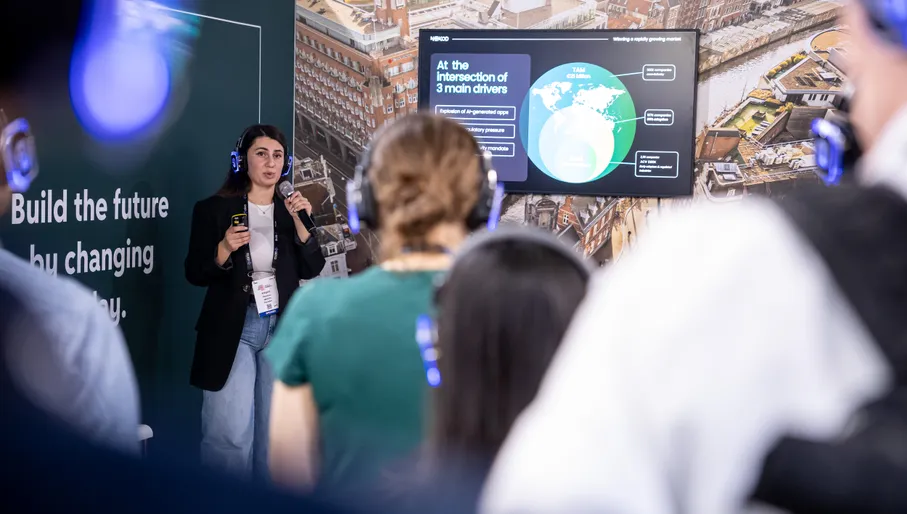
Meeting other startups in Amsterdam is definitely a perk, as is pitching on stage, making connections, and following up. In fact, after this interview I’m meeting someone I followed up with from World Summit AI.
Even on the client side, someone from a company was in the audience, and I connected with them. When your clients, partners, and people you want to hire are all in the ecosystem, it’s a great place to be.
For instance, at the World Summit AI’s Amsterdam Pavilion. Someone introduced me to Kaoutar Ashour, Programme Director of Scale NL. They bring Dutch startups to the West Coast. Even though I’m not joining via Scale NL, I’ll still get to connect with their network and be part of the local Dutch startup community.
What’s helped me the most is being part of communities. We as women need to show up more. The more you show up, the more you become part of the ecosystem.
We have group chats, we share information. Once you're in, gender stops mattering. You get invited to events and stay in the loop.
So that would be my first tip: don’t build in isolation. Do it as part of a community. It makes the whole process easier. That community could also be physical, like at AI Foundry.
Another important tip: make sure your personal finances are in order. If I were to start over—or if I were advising a young entrepreneur—I’d always stress this. When you're constantly worried about making it through the next month, that stress can cloud your judgment. Financial stability gives you the clarity and freedom to make better decisions.
I’m excited to join the Plug and Play accelerator in Silicon Valley this fall. It’s an amazing opportunity. I’ve heard a lot about the talent in San Francisco when it comes to tech products, so I’m looking forward to being there and having meaningful conversations.
I hope that when I come back, I can add to Amsterdam’s ecosystem and bring home the good things I’ll learn there.
The second thing is also related to San Francisco, but more on having investor conversations.
I’ve pitched to quite a few investors in Europe by now, I can kind of predict their comments—I know how they evaluate startups. I’m really curious to see how this is done in the US, and to compare the different angles.
If you’re a vibe coder—or have built something using tools like Lovable or other no-code platforms—we’d love your feedback. Especially if you’re using it for your company. It could be a small pilot, even free in that case, to help us evaluate our offering.
And I’m currently looking for a founding engineer to join me in shaping NEKOD’s next chapter.
I’m very clear on my message about female founders. Too often, it’s perceived as victimizing—like, “Oh, help us, we’re struggling.” But that’s not what it’s about.
It’s simple: be inclusive. Give female founders real opportunities, pay attention to what they’re building, and engage with them just like you would with anyone else.
More about #FoundersFridays
#FoundersFridays is an interview series about entrepreneurs, for entrepreneurs. Each edition features a founder sharing key learnings, milestones, challenges, and reflections—especially on Amsterdam’s role in the Dutch innovation and impact ecosystem.
If you’re an Amsterdam-based founder working on an innovative solution to an urban or social challenge, and you’d like to share your story with our audience, email Catalina Iorga.