#FoundersFridays: Meet Antigoni Kourou of NEKOD
17 October 2025
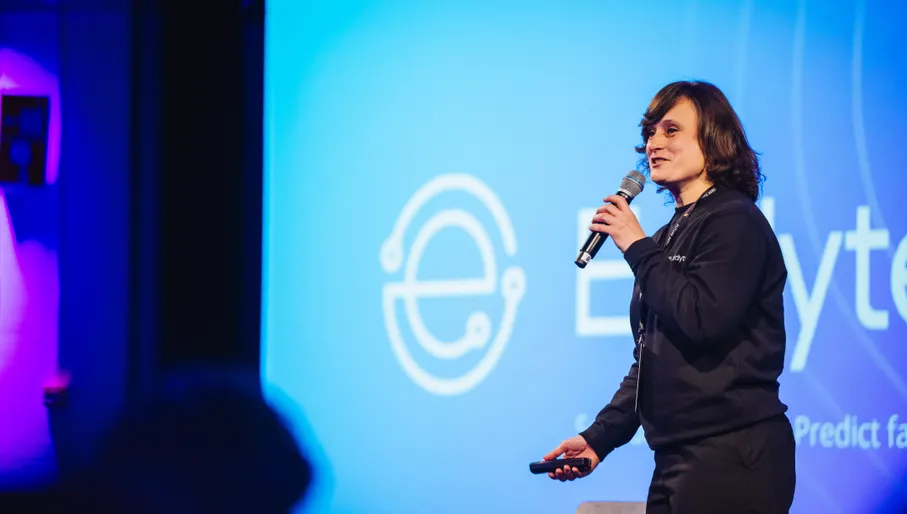
Eddytec's mission is to make testing in carbon fiber composites faster and simpler.
Carbon fiber composites are really awesome materials. They're strong and lightweight, and because of these properties we've seen a significant uptake in their use over the last 20 years across industries like aviation, prosthetics, and automotive.
Let's take planes for example. If we can make them lighter, there's less fuel consumption and fewer CO₂ emissions. Currently, the Airbus A350 is made up of more than 50% lightweight carbon fiber composites, and this enabled a 25% reduction in fuel consumption per seat.
The problem is that carbon fiber composites as material, though amazing, are complex, and need to be tested because even a small crack can lead to catastrophic failure. Testing is routinely done, of course, but here's the current problem: it is very complicated, very slow, and requires highly trained experts. And there's a bottleneck in the workforce.
Testing is also very expensive. In aircraft assembly, it accounts for 40% of overall manufacturing costs. In other manufacturing sectors, such as prosthetics or automotive, companies typically don't have the experts in-house and need to send parts to external labs, which is costly. Alternatively, they do internal testing by cutting parts open to look inside. This destroys the part and generates waste.
We're introducing a novel technology that looks at the conductivity of the material. By leveraging the underlying physics, we can do the testing much faster. Our current prototype is a handheld device that can easily be moved over the surface, and the results appear as a map with hotspots that show problematic areas.
This way of testing is easier to perform, meaning that a larger group of trained technicians can do it, and not only highly specialized experts. You can still have an expert review the data, but the measurement itself doesn't need to be done by them anymore, which helps reduce pressure on them.
Before co-founding Eddytec, I worked at another startup as Chief Technology Officer of Skytree. Before that, I was a scientist, but I really wanted to see technology turn into products. Skytree has an amazing mission: removing carbon dioxide from the air. Working there was great fun, but I decided I wanted to join a smaller company. I love solving problems, and joining a smaller startup felt like a better match for my skill set, where I'd feel more comfortable and challenged.
Through the Science Park network, I met my current co-founders, Rudolf, who's a physics professor, and Christiaan, who's an aerospace engineer. They came up with this technology and were looking for someone to help them build the company.
We spun out of the University of Amsterdam and the University of Applied Sciences, so it was natural for us to be here. One big advantage of being in Amsterdam is the abundance of international talent.
Our team consists of seven people with five nationalities. I love this mix of different perspectives and experiences coming together in one company. Having diverse talent is extremely important to us.
It's been great—we're still located at Science Park, where there are many startups. I have a peer group with other founders, and we support each other. Quite a few are science-based startups, which face very similar challenges.
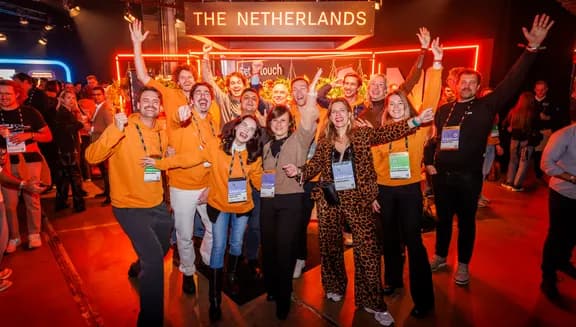
The City of Amsterdam has been extremely supportive. This year, we joined three municipality-supported trade missions and went to Tech BBQ in Denmark, Bits and Pretzels in Germany, and Slush in Finland. These events were really helpful for connecting with investors, especially because we're building hardware and the pool of relevant financiers is not huge.
It's clear that the Netherlands, and especially Amsterdam, have startup support high on their political agenda. At Slush, for example, the Dutch delegation was one of the largest ones, even larger than the German.
I'm really happy about the Dutch government allocating funding to support companies in the aviation sector. Through the Luchtvaart in Transitie (Aviation in Transition) program, we secured R&D funding together with our partner in Delft, a startup called Fiducial, to develop our technology specifically for aviation.
Though aviation is our holy grail, in the short term, we want to enter the market outside aviation, in areas like prosthetics or automotive.
We've also received letters of intent from major industry players and this gives us additional confidence that what we're building answers a real market pull.
The biggest challenge we're facing is funding. As a hardware company, we're capital-intensive. There is early-stage support from organizations like Innovatiefonds Noord-Holland, which has been great, but it still takes a long time to reach the market.
Our next step is venture capital. Right now, I'm working on securing our first VC round. The big challenge I see, and it's a shared observation among founders, is that even early-stage and pre-seed VCs ask for revenue. I think this approach risks shifting founders' focus from validation to monetisation too early.
Exactly. That's exactly where we are. I understand that VCs look for signals to reduce risk. But when revenue is expected that early, it can be counterproductive in the long run. Pre-seed VCs often say they invest in the team and the future market. I'd like to see more of it in practice. It's something that comes up a lot in conversations with other startups.
Next year will be exciting as we reach MVP and start our first sales. At this stage, it's critical for us to meet potential customers and show them our product. We can do initial demos online, but face-to-face, hands-on presentations work best.
That's why subsidies or support to attend trade shows would make a big difference. It saves a lot of time and money to meet several clients in one place, rather than travelling to each one separately.
One of the best pieces of advice I got was to listen to your gut. Take all advice with a pinch of salt, because as a founder, you have the best understanding of your company, market, and technology. Advisors need time to understand your situation and may not know all the details.
It's always good to learn, but ultimately, you need to make your own decisions and live with the consequences.
To dedicate time and effort to build a team. From my perspective, a successful company isn't about the technology, the customer, the market, or even money. It's about the people you bring on board.
To me it's important to hire not just for background, but for attitude. You need people who are genuinely up for the challenge and interested in startup life. Many people have a skewed idea of startups: ping-pong tables and free drinks. That might be true for well-funded scale-ups, but in the early days, you're scrappy and it's a lot of hard work.
Finding the right people, and sometimes waiting for the right person, is crucial. The cost of hiring the wrong person is much higher than doing the work of two people for a couple of months.
My experience in the Netherlands is that capital tends to be quite risk-averse, which is especially challenging for hardware companies. When VCs say they need half a million or even a million in revenue, I sometimes think: if we reached that point, we might not need funding anymore.
As I mentioned before, this isn't just our struggle, many startups face the same challenge. For hardware companies, it's even harder, particularly in the current climate.
So my message is simple: we need more risk-friendly capital.
More about #FoundersFridays
#FoundersFridays is an interview series about entrepreneurs, for entrepreneurs. Each edition features a founder sharing key learnings, milestones, challenges, and reflections—especially on Amsterdam’s role in the Dutch innovation and impact ecosystem.
If you’re an Amsterdam-based founder working on an innovative solution to an urban or social challenge, and you’d like to share your story with our audience, email Catalina Iorga.