
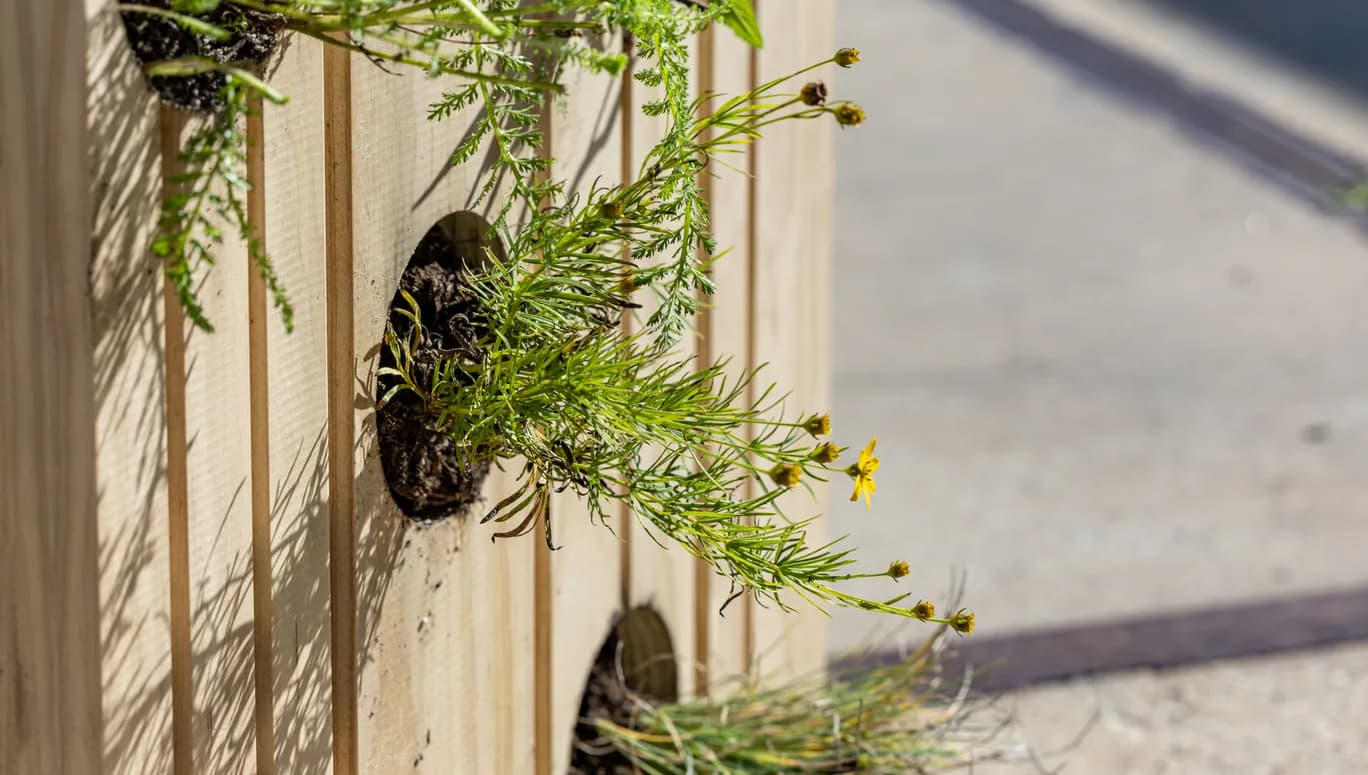
Leafy reimagines urban nature with living façade technology
Take the greener path
At the centre of Leafy’s story is co-founder Naud van der Padt, whose personal experience of moving from a rural village to the dense urban fabric of Amsterdam sparked the idea.
“During my studies in Global Business and Sustainability, I took a course that challenged me to create something that genuinely contributes to the world,” he explains. “Around the same time, I moved from a small town called Groenekan to Amsterdam city centre. The contrast was immediate. I felt the absence of green acutely.”
Living on Rokin in the very centre of the city, his daily routine revealed something subtle but telling.
“I had two routes to choose from: the main street, or the Nes, a narrow alleyway alongside it. The Nes had pockets of green, and I always chose that path without really thinking about it,” he says. “Whenever I returned to my parents’ home in the countryside, I felt instantly renewed, only to notice my stress levels rise again when I came back to the city.”
What began as a personal observation quickly became grounded in research. “I discovered that green has a measurable impact on mental wellbeing and cognitive capacity. That was the spark. We need more green in cities, but there simply isn’t the space.”
The solution, he realised, was not horizontal, but vertical. “I looked up and saw building façades everywhere. Vast, unused surfaces. I thought: what if we could click green panels onto those?”
These green panels can reduce surface temperatures of buildings significantly and help lower ambient air temperatures in dense urban areas. This directly contributes to mitigating the urban heat island effect, which is becoming a growing issue in cities like Amsterdam as summers get hotter.
Designing with nature, not against it
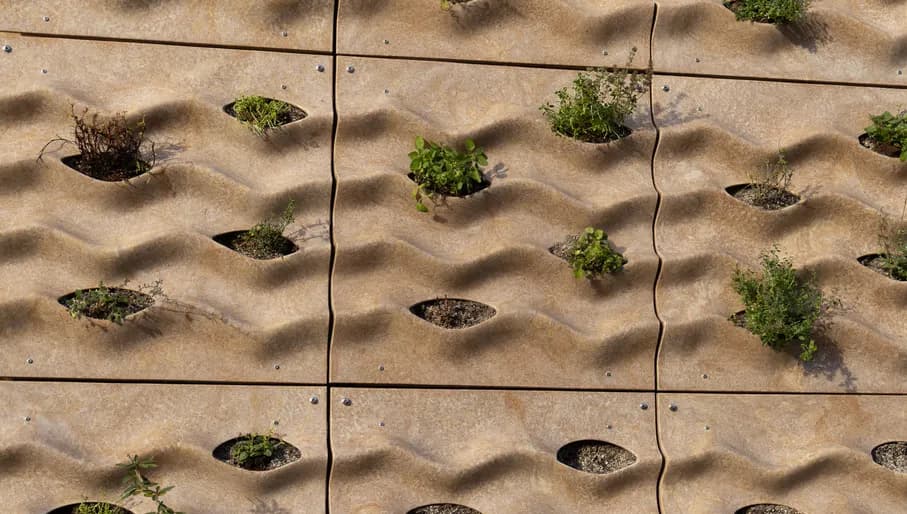
Leafy’s early development was not without setbacks. Initially, the team attempted to engineer a highly controlled, man-made system.
“Our first instinct was to optimise everything, to control how plants would grow,” van der Padt says. “We tested it, and we failed.”
A turning point came when the team shifted its approach towards biophilic design principles.
We asked ourselves: what if we design the way nature designs?
That shift led to the system Leafy uses today, biophilic design principles, operating without electricity, pumps, or artificial irrigation. Instead, it relies on natural processes and a regenerative substrate that supports microbial life.
One early test to see if this was indeed the right way to move forward became a defining moment for the company.
“A storm hit just after we planted our first batch. Some plants were ripped off completely. One of our larger plants was blown clean off the panel,” he recalls. “We thought: this is it, we need to go back to a man-made system.”
But nature responded differently. “Two weeks later, that same plant had grown back, this time horizontally, anchored against the panel. It had adapted to the wind conditions.
That’s when everything clicked. We realised: just let nature do the work.
“By working with nature not against it we can make real impact not just some green decoration and lower cost significantly compared to competitors due to lower initial costs with no need for expensive pumps, sensors and nutrient injectors which reduce maintenance cost.”
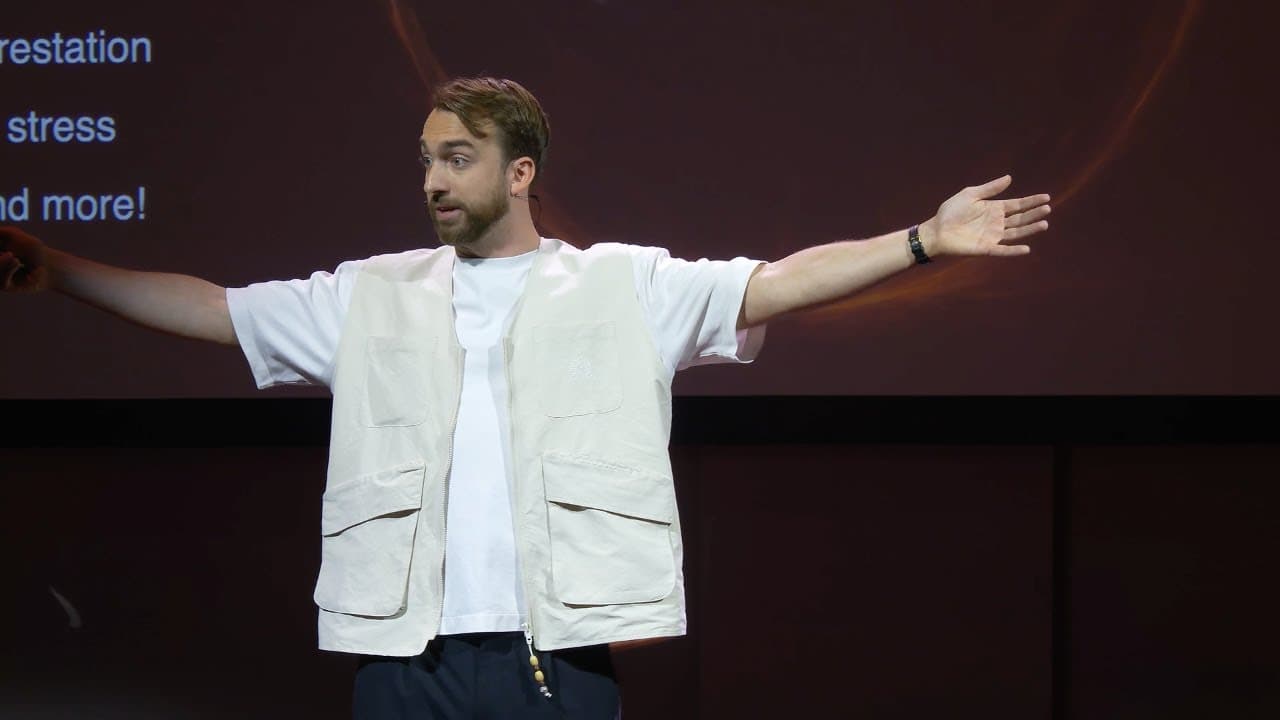
The vertical revolution: how green walls can heal our cities | Naud van der Padt | TEDxAmsterdam
From concept to construction
Turning that insight into a viable product meant entering one of the most complex industries: construction.
“Getting a hardware product off the ground in this sector is never straightforward. There’s a lot of legislation to navigate,” van der Padt explains.
Before founding Leafy, he joined one of the Netherlands’ largest contractors as a trainee, gaining insight into how the industry operates and meeting his co-founder in the process. After three years of development, the pair committed full time to the venture.
Now, the company is beginning to scale.
“We’ve developed our first panel, and we’re already working with multiple municipalities, contractors, and building owners across the Netherlands,” he says. “The first installations will roll out this spring and summer. That’s where we’ll learn the most.”
Beyond a single product, Leafy is also expanding its approach to urban greening. “We see the panel as one tool, not the only one. We’re exploring complementary solutions like climbing plants to broaden the ways cities can integrate green.”
An added bonus of working with nature is, vertical greenery creates microhabitats for insects, birds, and pollinators, especially in cities where ground-level biodiversity is limited. Even small pockets of vegetation can support urban ecosystems and help reconnect fragmented habitats.
Leafy also have fauna panels for bird/batboxes and insect hotels. “The combination with flora and fauna enhances and strengthens the vertical ecological system we're adding.”
A system built on circularity
Leafy’s model is closely aligned with Amsterdam’s circular economy ambitions, particularly in construction and urban development.
For us, circularity is about designing for the entire lifecycle from the start. Our panels are fully modular. They can be installed and dismounted without damaging the building.
With the material lifespan guaranteed for 50–60 years but actually lasting even longer than that, the company is also taking responsibility for reuse. “At the end of the lifecycle, we take the panels back and reinstall them elsewhere. That’s how we maintain value over time.”
The system is built around three principles: self-sustaining, nature-driven growth, and integration across architecture and construction.
“Our panels use existing rainwater or greywater infrastructure and distribute it naturally. No pumps, no complex systems,” he says. “And instead of feeding plants artificially, we rely on Micorbial life to generate nutrients within the substrate. That makes the system resilient and robust.”
Equally important is design. “We’re not just building green walls. We’re creating living walls that change with the seasons. In winter, the panel itself becomes part of the aesthetic.”
Amsterdam as a living lab for circularity
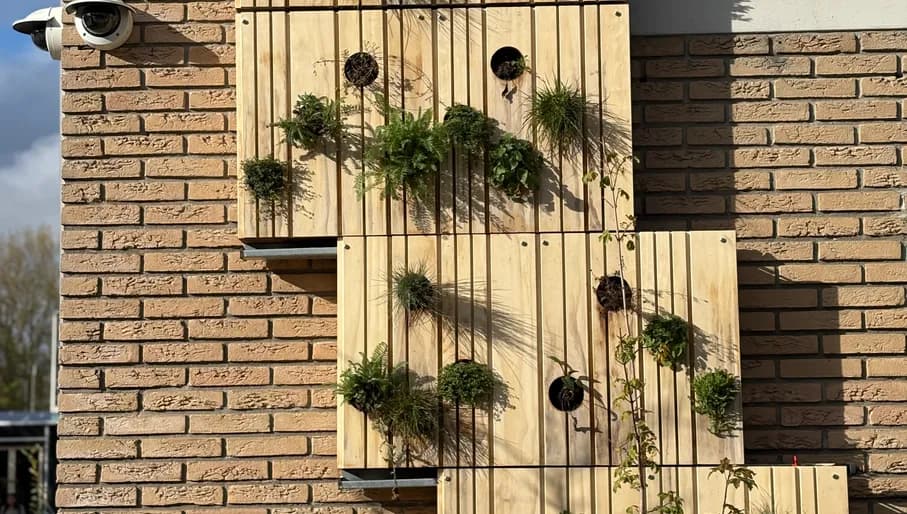
For Leafy, Amsterdam offers more than just a home base. It acts as a testing ground for innovation in the built environment.
“The city has ambitious goals around sustainability and circularity, and it genuinely wants to lead,” says van der Padt. “That creates real opportunities for companies like ours.”
Municipal support has been key in opening doors. “It doesn’t solve everything, but it gives us the chance to prove what we can do.”
Historically, he notes, Amsterdam has always had a close relationship with nature.
“There’s a quote, which can be found at the canal museum, from the 1600s: is Amsterdam a forest in a city, or a city in a forest? Green used to be embedded in how the city was designed,” he says. “Now, that balance is shifting back. Urban greening is becoming a mainstream priority.”
That momentum is now extending internationally. Leafy was invited by the Municipality of Amsterdam to present at the ChangeNOW Summit 2026 in Paris in April, which is widely regarded as the world’s largest sustainability gathering.
“We'll be showcasing Leafy alongside two other Dutch startups,” van der Padt says. “It’s the first time we’re presenting on a global stage.”
For a company designed with scalability in mind, the opportunity is significant. “Leafy isn’t tied to one city or country. This is about exploring where else we can make an impact.”
Rethinking the role of nature in cities
Looking ahead, van der Padt sees a fundamental shift in how cities approach the built environment.
The goal isn’t to have nature and buildings coexist side by side. It’s to fully integrate them. There’s so much unused vertical space in cities. Façades can become part of the solution.
To accelerate that shift, he believes policy and procurement must evolve. “We need more room for experimentation. Too many innovations get stuck in pilot phases because systems are built around conventional solutions.”
He also advocates for stronger requirements. “Nature should be treated as essential, not optional. Cities should set minimum greening standards.”
For startups entering Amsterdam’s ecosystem, his advice is clear: “Start with a real problem and build something tangible. And collaborate early. The ecosystem here is strong, but you need to engage with it.”
As cities across Europe intensify their focus on climate adaptation, biodiversity, and liveability, solutions like Leafy point to a broader transformation already underway.
“We have everything we need to rethink our relationship with nature,” van der Padt says. “The tools, the knowledge, and the urgency are all there. Leafy is just one piece of that puzzle. And we’re only just getting started.”