
Amsterdam-based ORE Energy raises €37.3 million to bring 100-hour batteries to market
The Series A funding will support the company’s first manufacturing facility and expand its manufacturing, commercial and operational teams. Ore Energy aims to reach gigawatt-hour-scale production by 2028. The investment round was led by Plural and HV Capital, with participation from Positron Ventures.
From rust to energy storage
Ore Energy’s technology is based on a surprisingly familiar process: rusting.
Wind and solar power do not always arrive when electricity is needed most. At times, renewable energy is produced faster than the grid can absorb it. At others, several days of limited wind or sunlight can leave gaps in supply.
Ore Energy’s batteries are designed to move electricity across those longer periods.
When the battery releases electricity, iron reacts with oxygen and forms rust. Charging the battery reverses the reaction, returning the material to iron so it can be used again. This allows the system to store electricity for between 24 and 100 hours, rather than replacing the shorter-duration batteries already used to balance power grids, Ore Energy is targeting the multi-day gaps that become increasingly important as more renewable power enters the energy system.The batteries do not require lithium or cobalt. Ore Energy says they can instead be manufactured through a European supply chain using widely available materials.
Towards commercial scale
The investment follows Ore Energy’s first major commercial agreement. In June, the company announced a 1 GWh partnership with Dutch energy supplier Budget Thuis, beginning with a committed 400 MWh deployment planned for 2028. As the batteries will store excess wind power and make it available during longer periods of limited generation, this agreement is being described as continental Europe’s largest commitment to iron-air storage.
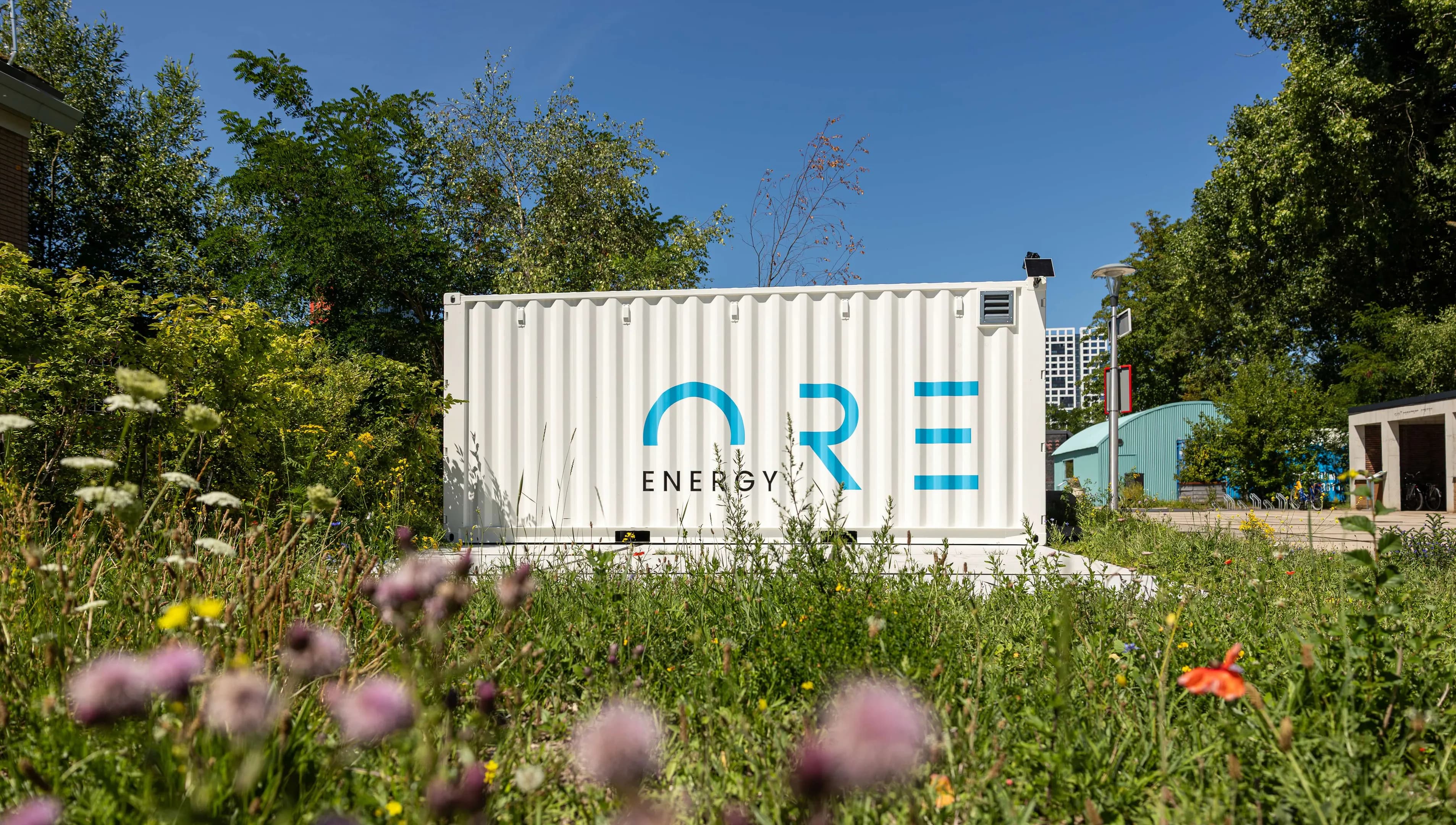
Ore Energy is also already testing the technology outside the laboratory. It connected its first iron-air battery to the Dutch grid at The Green Village in Delft in 2025 and has since completed a 100-hour pilot at an EDF research facility in France.
For Amsterdam’s renewable-energy ecosystem, that makes Ore Energy an interesting example of locally developed climate technology approaching industrial scale and of a deceptively simple material being put to work on one of Europe’s more complicated energy challenges.
Learn more about Amsterdam’s renewable energy and cleantech sector.